505Net is a type of net – it is not a proprietary net of any organization, and it is available for anyone to use. Like all SitRepNet projects, it is a system and a set of tools. If your radio group would like to include a 505Net in your activities, please do so – that’s what it’s here for.
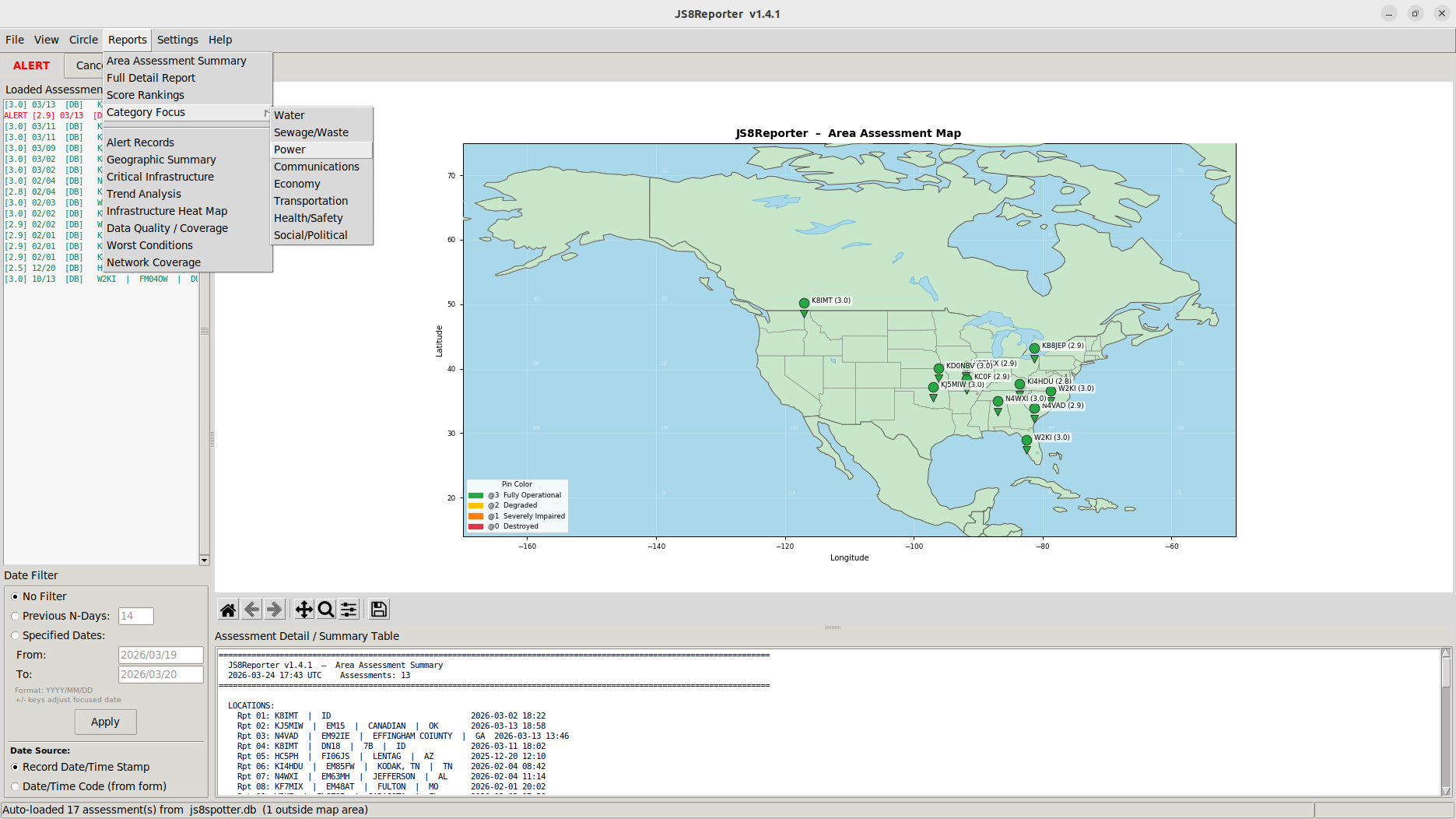
Click image for full size view.
Why was 505Net developed?
Most nets focus on training, and that’s a good thing. They pass something as traffic, but the traffic is mainly there to have something to practice with. The traffic is seldom unique or truly useful to the net participants beyond the experience of passing traffic. 505Net aims to change that.
- In an ideal world, a 505Net would not be needed – JS8Call/JS8Spotter would handle all of it since that’s what the F505 Area Assessment was designed for. In the real world, there are many stations that operate on other frequencies and modes. The 505Net fills that gap.
- All radio nets serve as training nets, including the 505Net, but that is not the primary goal for a 505Net.
- A 505Net is designed to be fast. Pass one type of traffic both ways, then close the net.
- Motivating and encouraging net participation by enabling net participants to display a map showing current infrastructure status, and create text reports that drill down to show important details. In addition, the map has a Time Lapse feature that displays changes over time – not just a static snapshot.
- Encourage the widespread and routine use of the F505 Area Assessment form with JS8Spotter/JS8Call.
How does a 505Net work?
- Early check-ins accepted using Contestia 4/250
- NCS starts net and switches to MFSK32
- Check-ins are only from stations with one or more F505 reports to send.
- NCS sends TFC sequence so stations know their spot in the list
- First group of stations (typically a group of 3 stations) send their F505 reports using FLAMP
- NCS asks for any fills needed, then goes to the next group until all incoming TFC has been passed
- NCS uses the 505Processor to compile all received reports into a single, compact file
- NCS sends that file (a file containing 50 Area Assessments, each containing 32 different items, can be sent in 11 blocks taking only 2 minutes, 36 seconds.)
- NCS calls for any needed block fills and/or begins relays if needed.
- Net is closed and switched to Contestia 4/250 as a courtesy to others.
Note that this is just the suggested sequence – feel free to change it as needed for your own requirements.
What is needed for a 505Net?
- FLDIGI and FLAMP
- JS8Call – though reports can be created and imported into JS8Reporter without JS8Call, being able to independently receive reports is fundamental to the 505Net project.
- JS8Spotter – This creates the F505 Area Assessment report that a 505Net is based on.
- F505 file – This comes standard with JS8Spotter.
- JS8Reporter – This turns the raw data into useful information in the form of a user-configurable map, and multiple detailed reports.
- 505Processor – This NCS tool reads the received traffic (F505 Area Assessment reports), removes any duplicates, removes any fields that are no longer needed, and compiles them all into a single file that is sent out by NCS after all reports have been received. Only the NCS needs this.
- FLDIGI Macros – (still being worked on) This set of macros is designed specifically for a 505Net, but feel free to modify to meet your needs.
