The SitRepNet Project

➊ It is a set of tools and resources for HF digital mode nets and unaffiliated information sharing. It is “Neutral Ground” to coordinate among nets, and avoid schedule conflicts. A major part of this is maintaining a current database of HF digital nets.
➋ Encourage and facilitate the independent gathering and distribution of information via HF Digital modes using JS8Spotter and SitRepMapper, and coordinate the flow of information through the SitRepNet CommPlan.
Why? Because the communications system that our modern society depends on is complex and extremely fragile. We stand ready, in some small way, to help fill that gap when (not if, but when) the system fails.

F-309 Reports sent with Earthquake selected, and “Exercise” included.
➊ Click here for the HF Digital Net Database
➋ Click here for the SitRepNet CommPlan
➌ Click here for SitRepMapper software
A Focus on Civil Infrastructure
The digital reports exchanged by SitRepNet are focused on domestic civilian infrastructure and supply chain issues. We don’t use tactical-oriented reports such as SALUTE or 9-Line Medivac reports: there are other nets better suited for that, and they are doing a fine job of it. Our focus is on things that affect ordinary people just trying to live their lives. Some examples:
• Availability of fuel
• Power grid status
• Local stock of food and other essentials
• Communications (phone, internet, media)
• Transportation (roads, bridges, airports)
• Civil disturbance
• Public services (police, fire, medical)
• Severe weather and natural disasters
Our goal is to not only exchange information, but to package it into a useful form. Raw data is turned into color-coded map pins. A time-lapse map feature adds trend analysis perspective to a changing situation. Summary reports turn a group of static reports into useful information. We strive to build a broad, high-altitude picture as well as focusing down to the neighborhood level.
The Tools We Use
• JS8Call – The digital mode and primary radio connection.
• JS8Spotter – A very flexible system of exchanging reports.
• SitRepMapper – Topo map based: the primary SitRepNet tool.
• MCForms – Flexible multi-choice report forms.
• SitRepNet CommPlan – How it all works together.
• SitRepNet Install/Update Script – This script will automatically install/update 7 essential digital radio programs on your Linux or Raspberry Pi system.
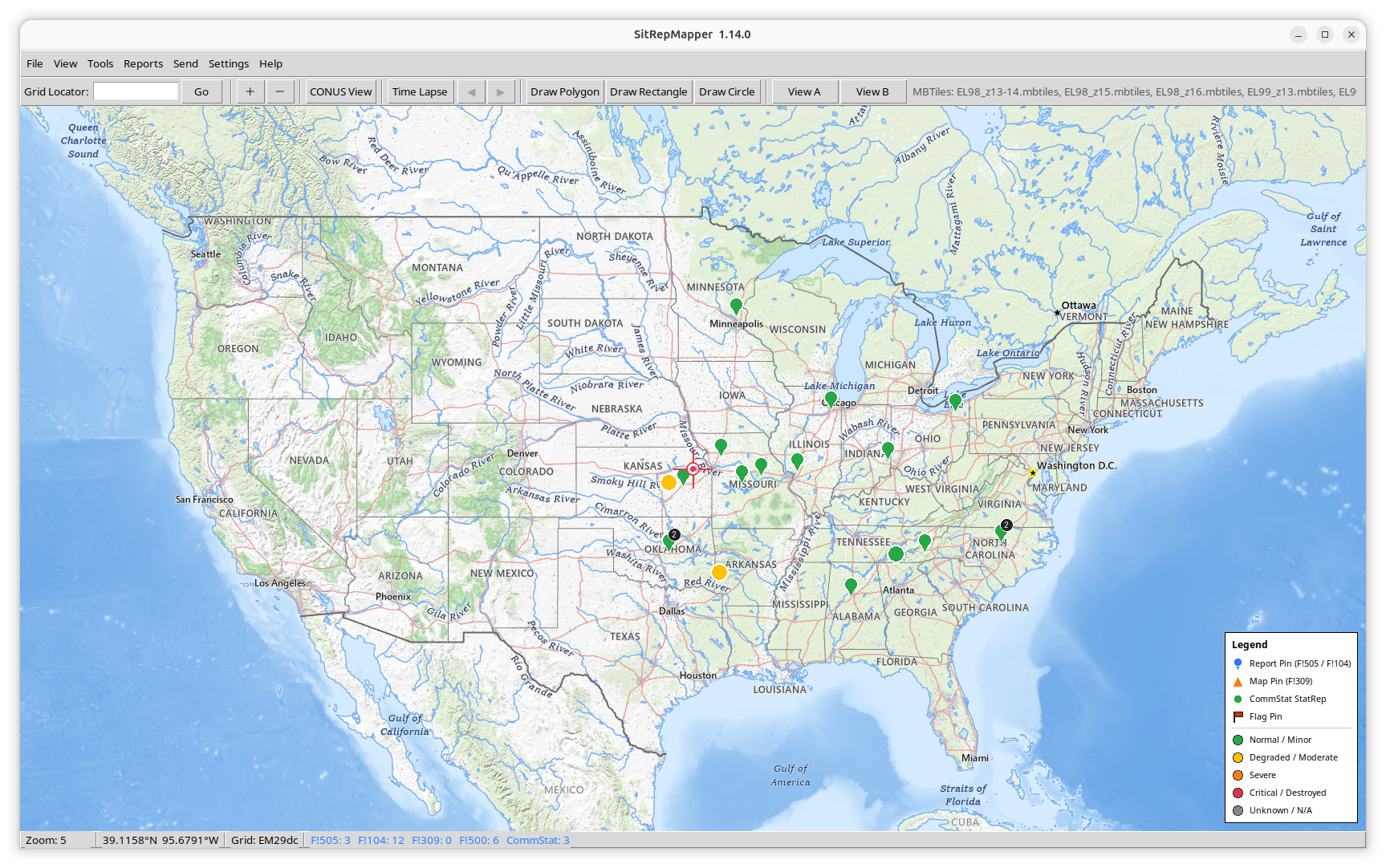
SitRepMapper
Add @SITREP to your Groups
The @SITREP group designation is for unaffiliated SitRep reports and related information sharing. Organized net groups do some great things, and we encourage you to participate in them, but open, decentralized sharing of information among individuals and small local groups is just as important. Add @SITREP to your “Groups” to help make that happen.
The SitRepNet Communications Plan (CommPlan) provides the structure for a decentralized way to share Situation Reports (SitReps), arrange impromptu nets to address specific events, and collect and distribute information at the local level. The SitRepNet project is, in essence, establishing a common language to allow individual stations to more effectively communicate without using the command structure of a conventional net. It is a network, but not a net. Nets are important, and SitRepNet works alongside established organized nets to share information that formal structure nets cannot efficiently do while maintaining their core objectives.
Core principles of SitRepNet:
• SitRepNet is completely open. There are no “secrets – just in case”. There is no “membership” in a group, no cost, no
fees, and no records. All plans and resources are available to anyone by going to https://sitrepnet.com/.
• SitRepNet is decentralized. There is no “command structure”. It is designed to be used by any licensed ham radio
operator, and it depends on individual ham operators taking the initiative and doing what needs to be done.
• In operation, SitRepNet does not connect to the internet, repeaters, or anything other than point-to-point radio connections.
• Simplicity is how an effective network can be built without a central command structure. It depends on individual radio operators combining their own initiative with the basic SitRepNet plan and tools, and making it all work together.
